


UN Security Council Convenes Emergency Session Amid Global Backlash to Israel’s Recognition of Somaliland
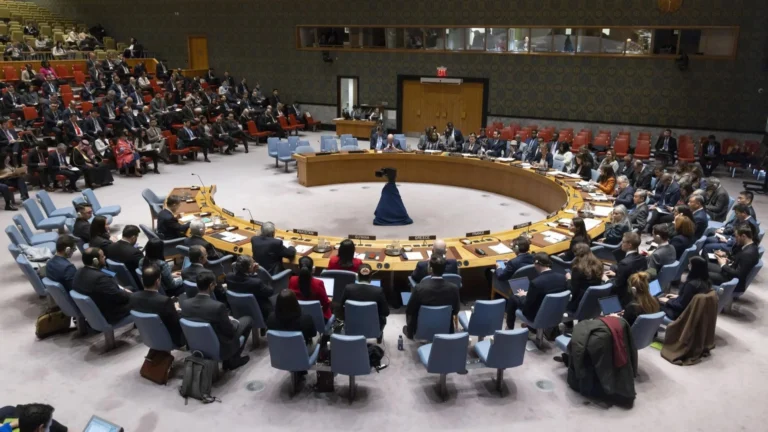
(FILE) UN Security Council. Photo. EFE.
December 28, 2025 Hour: 1:52 am
🔗 Comparte este artículo
The United Nations Security Council has called an emergency session for Monday in response to Israel’s controversial recognition of the breakaway region of Somaliland, a move that has sparked a wave of global condemnation and accusations of violating Somalia’s sovereignty and international law.
The United Nations Security Council has convened an emergency session for Monday, December 29, following Israel’s recognition of the separatist region of Somaliland. The meeting takes place amidst growing criticism of the international body’s ineffectiveness in halting unilateral actions that violate international law and state sovereignty.
Regarding the scheduled meeting, Israel’s representative to the UN Danny Danon said that Tel Aviv “will not be deterred by unnecessary political discussions.”
RELATED: Venezuela Rejects Israel’s Recognition of Somaliland
Benjamin Netanyahu’s far-right administration seeks to establish a cooperation agenda in technology, health, and security with Somaliland, as the self-proclaimed Government of Abdirahman Mohamed Abdullahi expressed willingness to join the Abraham Accords.
The Zionist agenda has drawn wide criticism across the globe. While countries such as Egypt, Türkiye, Djibouti, and Venezuela have expressed their rejection of this violation of Somali sovereignty, the UN arrives at the discussion after the Somaliland-Israel agreements have already been sealed.
Somalian President Mohamed Farmaajo said via his X account that “international law requires Israel to comply and respect the territorial integrity and sovereignty of Somalia. Recognizing a part of Somalia is a complete breach of this.”
Cross-Regional Rejection
Citing “serious repercussions” of the Israeli-Somaliland alliance “on peace and security in the Horn of Africa, the Red Sea, and its “serious effects on international peace”, a joint communiqué of “unequivocal rejection” was signed by Egypt, Algeria, Comoros, Djibouti, Gambia, Iran, Iraq, Jordan, Kuwait, Libya, Maldives, Nigeria, Oman, Pakistan, Palestine, Qatar, Saudi Arabia, Sudan, Türkiye, Yemen, the Organization of Islamic Cooperation, and Somalia’s legitimate Foreign Ministry.
“The recognition of parts of states constitutes a serious precedent and threatens international peace and security, and violates the cardinal principles of international law and the United Nations Charter,” the statement read.
Likewise, local U.S. media reported that Washington will not recognize Somaliland as and independent state for now, although President Donald Trump is said to be studying the matter.
For his part, the president of the Commission of the African Union (AU), Mahmoud Ali Youssouf, affirmed in a communiqué that “any attempt to undermine the unity, sovereignty and territorial integrity of Somalia contravenes the fundamental principles of the African Union and could set a dangerous precedent with profound implications for peace and stability throughout the continent.”
The Ministry of Foreign Affairs of the Palestinian National Authority, also rejected Israel’s recognition of Somaliland as a sovereign state on the grounds that it undermines the sovereignty of Somalia, and recalled that Israel might be looking for a destination to expel the Palestinian people.
“The Ministry of Foreign Affairs and Expatriates of the State of Palestine affirms its absolute support for the unity, sovereignty and political independence of Somalia, and opposed “any measure which supports or legitimizes secession (…) and undermines its stability.”
The Somali Crisis
The fall of Mohamed Siad Barre’s regime in 1991 marked the dissolution of Somalia as a unitary state, leading to territorial fragmentation. Although the international community recognizes only the Federal Government, its effective control is limited and concentrated mostly in the capital, Mogadishu, and other specific sectors of the country.
The absence of a strong central command fostered the emergence of regional administrations that now operate autonomously. Among them, the Republic of Somaliland in the north stands out, exercising unrecognized de facto sovereignty, and the Puntland region in the east, which has maintained its own self-governance framework since the late 1990s.
Author: Victor Miranda - LVM
Source: Agencies